The second day of the KDE 4.0 Release Event in Mountain View, California, was a very busy day. Reporters and users joined the hackers, peeking over their shoulders, asking questions and generally trying to figure us out. Talks were given - most notably the keynote by Aaron Seigo, but also covering KOffice, the KDE-Edu project, and multimedia. Read on for more details.
Today we were joined by even more hackers and others outside our own project, like representatives from AMD, Sun, Kubuntu, Mandriva, SUSE, and most of the Slackware team. Even some kernel hackers showed their faces, which resulted in a kernel discussion meeting.
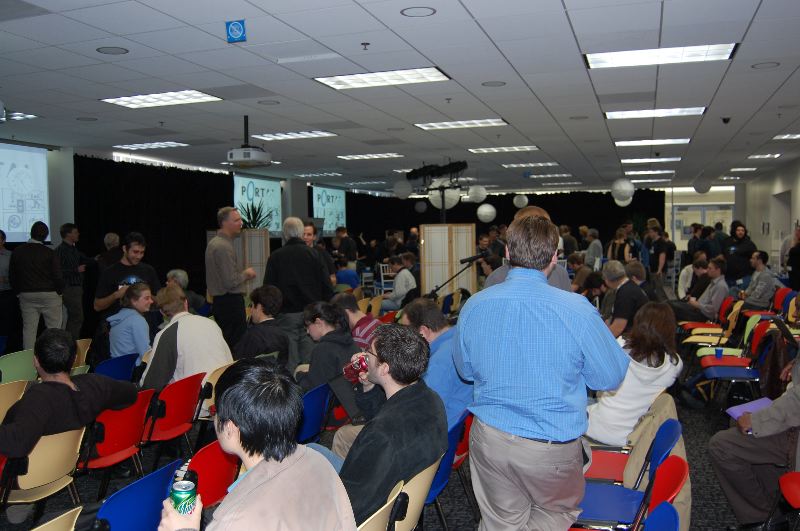
The day started with Adriaan de Groot introducing the release event, mentioning that this is not just a technical event, but also very much a social one.
Aaron Seigo, President of the KDE e.V. then began the keynote, with an introduction to KDE 4, talking about with the history of the project and expressing how far we have come in the last 11 years. Then, Aaron explored what KDE is, and what our community is based on - freedom and openness. Freedom to do work, have fun, and connect with others. Further, Aaron moved on to KDE 4, and discussed the near-future plans and ideas. The vision of KDE 4 is based upon three principles: beauty, accessibility, and functionality. He ventured into the many areas that KDE has improved upon, and pointed to our roadmap for the KDE 4 cycle.
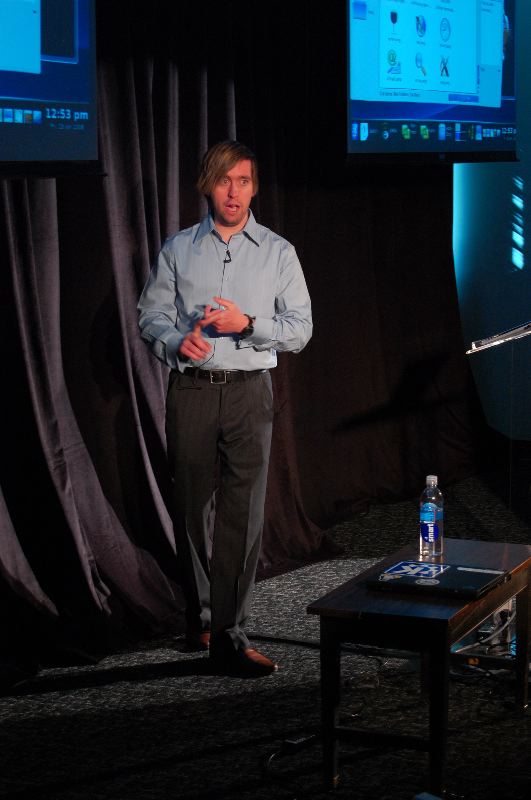
Aaron explained how users expect certain things from their computer, like games, internet connectivity, communication. So we have to meet those expectations. KDE 3.5 already widely met these goals, and so for KDE 4, we had to do chase new ideals. Aaron talked about how KDE is put together, how KDE uses many frameworks and other technologies, and introduced individually introduced them to the audience.
The audience watched an impressive video of the new KWin compositing features, and later, Aaron demonstrated KDE 4 applications live to the audience. After showing the state of our current KDE 4.0 release, Aaron continued with the roadmap for KDE 4. When can we expect KDE 4.0.1, 3.5.9, when will KDE 4.1 arrive? For those curious, that would be respectively this month, next month and July. Furthermore, the future is bright, as KDE will no longer be restricted to running on Linux, BSD and Solaris - yes, Windows and Mac OS X will be supported officially as well for KDE 4.1. KDE-on-Mac and KDE-on-Windows developers came up on stage and showed us what they have. Benjamin Reed, the leading KDE-Mac developer showed us Konqueror, KStars and several other applications on Mac OSX, then Holger Schroder demoed KDE-on-Windows.
Aaron continued, and showed us some crucial applications like KPat (the solitaire card game!) and the scalable graphics it now has. Marble and the OpenStreetMap project were discussed, and finally it was time for questions. Icons, mixing a KDE 4 desktop and KDE 3 applications, the target group for KDE 4.0, and the viability of large deployments were discussed, and Aaron ended the talk with some teasers concerning Media Center systems. The keynote was streamed to several of the KDE 4 release parties worldwide, and it will be put on YouTube and made available for download as soon as possible. Look out for an announcement on the Dot, probably at the beginning of next week!
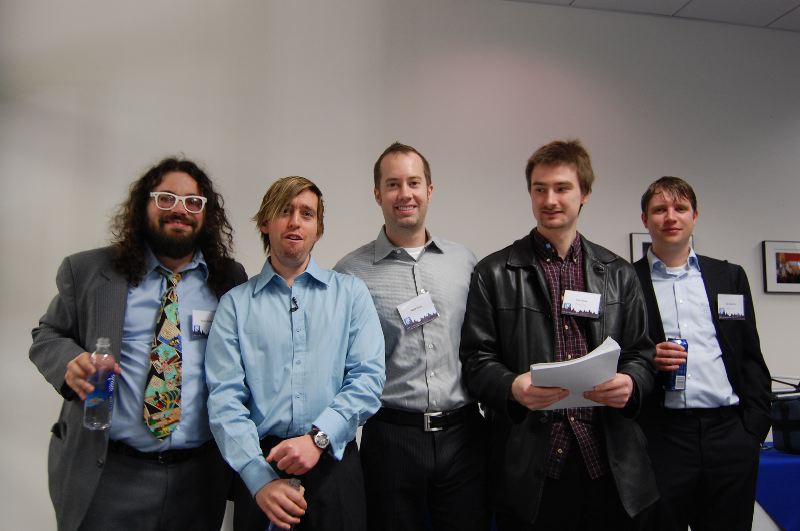
The next speaker was Inge Wallin, who showed us KOffice and the many improvements it has seen since its last KDE 3.x release, KOffice 1.5. Inge began by introducing the many components KOffice consists of, which is fairly impressive in itself - KOffice is the most comprehensive office suite in existence. The KOffice architecture provides for a large amount of flexibility, where users can mix and match any type of object into any document you want. So you can have a chart in a picture, use graphical effects and vector graphics in your spreadsheet, or have music notes in a vector graphic.
Inge continued talking about ODF and standards, telling us how KOffice was the first office suite to support ODF, and how the KOffice developers are working closely with the OASIS standards committee to ensure the long-term viability of the format. As with the KDE desktop, KOffice is also portable to Windows and Mac OSX - portability and integration are definitely the strong points of KOffice. Embedding in Konqueror or other applications, working with the okular developers - in time, the OpenDocument support from KOffice will end up in the KDE libraries, so that any KDE application will easily be able to support the format. Interest has already been expressed by several KDE-Edu developers.
Further, Inge went on to demonstrate some advantages of the flexible structure of KOffice, which leads to abilities like easy automation and integration into specific workflows, and the ease of extensibility. Real examples of these attributes were provided, such as a version of KOffice applications with a simplified user interface, the music notation shape, KDissert (mind mapping), and Inge also mentioned the start of the KOfficeSource support company.
After the KOffice talk, Google brought in some excellent food and we continued with a talk from Haavard Nord, the CEO of Trolltech. Haavard talked about the symbiosis between the KDE project and Trolltech. He began detailing the state of the Linux desktop in 1996, when KDE was started. The biggest challenge back then was that writing a GUI application was very hard. A simple "hello world" application, based on the technology available back then needed more than 200 lines of code. The founder of KDE, Matthias Ettrich, wanted to use Qt, the premier Trolltech product, because Qt would make it much easier to write a full desktop. Trolltech was founded only 2 years before KDE, and has now grown into a company of over 250 employees, thousands of clients, and many thousands of Open Source developers using it in their projects.
Haavard continued explaining their business model (dual-licensing: GPL and a proprietary license), and he explains how Trolltech makes money from proprietary software developers in order to improve their product for everyone. So for instance, Skype and Google Earth help fund the development of the Qt framework, which in turn benefits us all. Trolltech receive almost half of their customers through their connection with KDE, and many improvements to Qt are suggested or even provided by KDE developers, for example the Phonon multimedia framework. Further, Haavard talked about Qt 4 and KDE 4, how they improved Qt, and how KDE can (and does) benefit from it. A great piece of news is that Qt 4.0 will be available under the GPL version 3 license, effective immediately. The KDE project is very happy to receive this news, and KDE has been working on our own license transition in order to take advantage of other Open Source projects, such as Samba, which have already made the switch. According to Haavard, Richard Stallman had noted that he "was very pleased that Trolltech has decided to make Qt available under GPL v3".
Next up was something very exciting, the Linux MCE people had finally arrived at the Release Event. They showed a demo video showing the great functionality of LinuxMCE, and even provided attendees with free LinuxMCE DVD's containing a 20-minute installation guide movie and a full software stack. Then, Aaron Baalbergen from Pluto started to talk about the future of Open Media Center software. LinuxMCE wants to integrate tightly with KDE - both in the area of underlying frameworks, and in the user interface. Technologies like Phonon and the other pillars allow them to improve their technologies faster while also bringing new functionality to KDE.
A question that came up was how the ecosystem worked. There is a company, Pluto, which is behind the code of LinuxMCE, but while they released the software for years, it wasn't used a lot outside of their company. The LinuxMCE project turned this around, and Pluto supports the project in getting a wider audience. They hope to work with KDE and get improvements into the software which will then be available to everyone, so they can become more interoperable and working together, creating an ecosystem which helps them to improve their software further. The final plan is to do what Trolltech does, and give their product away under the GPL while collecting money from those who don't want to release their software under the GPL.
After a short break, we had Kyle and Aron, the winners of our "all expenses paid" release event invitation contest on stage. They were asked to say a few words on their winning entries. They expressed their thanks to the KDE contributors, and offered us free beer!
Paul Adams of Sirius talked about how the Free Software community has matured over the years into a complete product ecosystem. It is no longer just about development, but also about artwork, marketing, selling... and also research? Large parts of the community have traditionally been slow to formally embrace research in their work. Through SQO-OSS and NEPOMUK, KDE has indirectly benefited from millions of Euros in public funding with noticeable effects on the KDE 4.0 release. Strigi is a great example of this within KDE. However, KDE can still do more in this arena. If we can develop a culture of embracing both formal and informal research efforts throughout our work, then the results can be even stronger than we have seen to date. In the Free Software world, we don't have commercial shareholders to worry about, and so we can afford to ask questions and be more creative in our endeavours (because instead of shareholders, we have users who want cool software). By engaging in research and with researchers, we place ourselves in a much better position to deliver.
The sixth talk was by Jeremy Whiting on the KDE-Edu project, which started with a brief history of one of the most popular and active KDE sub-projects. Jeremy explained how many KDE-Edu applications are often used to showcase the great stuff KDE has, as they often look very cool - and KStars is a prime example of this. The educational apps also attract many new users and developers, and give the KDE libraries a good workout. Good examples are the many issues the education applications exposed in KIO, the SVG rendering engine, Phonon, GetHotNewStuff (of which they are clearly the largest user), and many other frameworks. Jeremy showed off the many cool and sexy features from KDE-Edu, from applications like KAlgebra, Kalzium, Parley, Step, and Marble. KStars was actually demonstrated by Jason Harris, its main developer, who showed how educational KStars can be. KStars should be in every science classroom, and thanks to the release of Qt 4 for Windows and Mac, we will hopefully see that happen in the future. As you can imagine, this would bring many new users and developers, and the KDE-Edu people are very excited about that.
Next up was the Amarok talk, where Jeff Mitchell explained how Amarok wants to help us all to "rediscover" our music. Amarok 2.0 aims to redesign their most appreciated feature, the context browser. Currently, it is a HTML-based view, and there are some issues with that. It is not incredibly fast nor without rendering glitches, and it is not enormously flexible either. So something new was needed. It was decided to base the new Context Browser on Plasma. It was easy to use for Amarok developers, and is fast and flexible. And Qt 4.4 will introduce QtWebkit, so that they can still render HTML if they want.
Another area where Amarok 2 is focused is on hardware support. The current hardware support implementation is pretty complex, and still doesn't always work. KDE's media manager had some limitations, and Amarok had a lot of complex, custom code to be able to handle more than just generic storage devices. They are closely working with the Solid developers to ensure that Solid delivers what Amarok needs. A lot of work was spent on working with the hardware abstraction layer technology to ensure that it all works properly. The third focus of Amarok 2 is portability - they get hundreds of requests to get Amarok on Windows and Mac OSX, and they want to cater to that user segment. The opinion of Amarok developers is that running Free Software on proprietary platforms is better than running proprietary software on proprietary platforms - so Amarok on Windows or Mac OSX is a good thing. At first they planned to get rid of KDE and go Qt only, but now, with KDE available across platforms, Amarok can continue in the KDE family. Phonon is an essential component in the cross-platform implementation. Another big reason to work with KDE is the friendly developer community which didn't make it a burden to contribute back, but made it fun. The Amarok developers are incredibly happy being part of the KDE community and are proud to be a part of KDE Extragear.
After this last talk, we were treated to cocktails, accompanied by excellent Japanese-inspired food. We spent another hour at the Google headquarters socialising, before going back to the hotel, where the fun and interesting discussions continued long into the night. And the Karaoke is always enlightening. Really an excellent, interesting and productive day for the KDE community in North America!
Some pictures of the Release Event are available here.
Comments
This is a great review. If you read this it is almost like you're there.
Lots of info about what's going on within KDE.. all seems very positive.
thank you, it is a pleasure to write them. Note that i seem a better writer than i am thanks to the great editing danny does.
I agree.. Thank you so much for posting this!! :)
why's that damn video available only next week???
/me clip-clops his hooves in impatience
1. Youtube sucks regarding quality, and the lenght is limited, too. So Please use GOOGLE VIDEO, since it allows for better quality.
2. Your organisation is great normally, but this time it really sucks. Lots of people couldn't be there or on an official release party. It shouldn't be that hard to just take the video and upload it within an hour after the keynote is finished.
This is a great opportunity for kde PR-wise, why don't you take the opportunity and try to communicate the "be there" feeling to the world by being a bit quicker about all that?
Both YouTube and Google Video, thank you.
we had a live stream to the release parties but bandwidth was limited. We also tried to get help from fluendo but they were not very responsive. Finally google offered to help but they couldn't do realtime. Well its already online so not that bad.
>> Well its already online so not that bad.
Keynote was finished around Friday 20:30, and to my knowledge it took until Saturday close to midnight until it was up. That's really bad imo, considering that there are fans out there waiting and wanting to share the experience.
Don't get me wrong, i appreciate it, but i wished someone just would have taken the video and uploaded it to youtube or google video within the day of the keynote.
I think we have been spoiled by Apple Keynotes (Stevenotes :p) and expect everything to be a grand scheme and be streamed right away to all devices possible..
Give those guys time..
Yea, I'd prefer something higher resolution than Youtube (hopefully Google is reading this and considering bumping the YouTube resolution...) but I'll take what I can get. :-)
http://franz.keferboeck.info/gallery/main.php?g2_itemId=565
coolest thing ever :)
lol @ these:
http://franz.keferboeck.info/gallery/main.php?g2_itemId=513
http://franz.keferboeck.info/gallery/main.php?g2_itemId=522
http://franz.keferboeck.info/gallery/main.php?g2_itemId=525
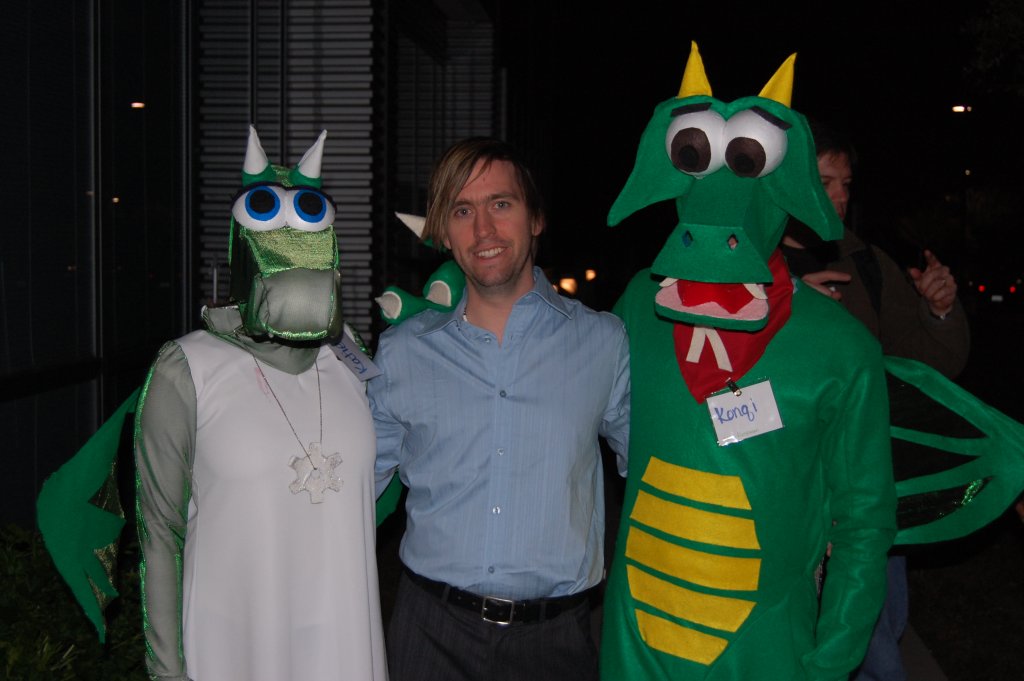
I had heard that Konqui and Kate were going to make an appearance, but wow they look great.
Yeah, that's what i thought! :) Now, i'm just left wondering - will our honoured mascots be visiting FOSDEM, so that Amarok's mascot Mike can meet them? ;)
Awww.... They're cute...
I gotta show them off to my friends later today. :)
Those KDE mascots are rather ugly, why doesn't KDE with 4 now released hold a comp to design and vote for a new mascot. Those are really uninspiring that look like some child put them together.
Obviously a comment from someone not actually at the event: these guys were great, and one of the (many) highlights of the event. And the costumes are technically excellent, and very true to the mascot design.
A mascot is not a logo, and in KDE 4.0 the use of the Konqi mascot throughout the KDE interface has been scaled back for reasons of "professionalism". So what is the issue with keeping a fun and long-serving part of our project alive at events like this?
Danny
The costumes don't look extremely professional, but the mascot artwork is pretty nice.
The costumes were actually professionally designed based only upon konqi/katie artwork that was available on the internet. I had seen photos of their design sessions with the costume designer they used, and they are quite good up close too!
(This has nothing to do with the costumes or event, I think that people dressed up as Konqi is an awesome idea!)
I agree with the grandparent about the current Konqi imagery. I think in the same way that the K-gear was improved for KDE 4.0, someone should improve the Konqi mascot for 4.1. The current Konqi looks sadly dated and out of place, and a little cheesy. I'd like to see an SVG remake. Something professional, but fun. I mean, he's a dragon right? Dragons are COOL! Or at least they can be. Konqi could be a big draw for users; I mean, who could resist a desktop environment with a sweet dragon as it's mascot? (Especially when the competing mascots are a window, a foot, and an apple. ;-)
The "window, a foot, and an apple" are logos, not mascots!
The KDE logo is the K surrounded by a gear that is seen in the bottom left of a KDE desktop and elsewhere.
Danny
Ok, there's a point. Windows and OSX do not have mascots technically, I guess. Would a penguin be Linux's mascot and the little devil (daemon?) be BSD's mascot? Or is the penguin a logo, because there is really only one popular image of him? I apologize for not knowing exactly the difference.
Anyway my point is similar to Richard's point (as expressed in his second post, http://dot.kde.org/1200788475/1200797159/1200799340/1200821861/). However, I'm thinking just about the artwork in the "About KDE" and "Log Out" dialogs. I noticed the Log Out dialog switched from showing Konqi to showing the moon, presumably because the old Konqi "photo" wasn't cool or professional enough. That made me sad, because Konqi is part of KDE's heritage, and dragons are cool. If we can't display him proudly in our artwork, we should update his photograph so he fits in with the Oxygen/Plasma "aura". If Konqi and Katie are 3D models on somebody's computer (the images I've seen of him look like CG) then some inspired people should have a contest to recreate the models in Blender or something similar. Add more detail, such as scales and sub-surface scattering (or whatever 3D artists do these days) to make some sweet, realistic renderings. Just like how Peter Jackson improved King Kong while keeping true to the original's spirit, we could have a more detailed model of Konqi.
I noticed that this 2007 video (http://www.kulma.org/linux/kde/kone.php?categ=anims) portrays Konqi is a sea serpent, which is a nice twist (I think sea dragons are cooler, more like traditional Chinese dragons - and it makes Konqi seem more international). There's no reason Konqi couldn't be a sea serpent, or have bigger wings, etc., as long has he keeps the "green, friendly dragon" concept.
Konqi is a blender model: http://www.kulma.org/linux/kde/kone.php?categ=model
Apple's unofficial mascot is Clarus the Dogcow. Tux the Penguin is both Linux's logo and mascot. Windows doesn't have a mascot (unless you count Clippy). On the other hand, most colleges and universities have both mascots and logos, as do sports teams. I'd say KDE's use lines up pretty much with the university use... for promotional events and things like clothing and toys, the mascot is used. For identification (for instance, login and logout screens), the logo is used.
By the way, I saw Kandalf recently off to the side of the road with a handlettered sign "Will mascot for bandwidth". Very sad.
If that's the best complaint you can come up with, then I think it's clear the KDE team has done a fantastic job.
wrong a mascot can, if done right pull in clients, get people switching to it. KDE needs a new mascot for 4 (Not logo, I didn't say logo, and I know the difference, but you obviously can't read, and decided to put that in there) There should be a comp to design a new mascot, one that looks better than those ugly things. You want to inspire people to come to it, having those two ugly mascots aren't going to do it. They may bring in the nerds at google, but you want to bring in the regular folk that aint inspiring, actually they are very ugly.
What kind of reasoning is that? KDE isn't a junk food restaurant or a theme park! It's a desktop environment and the best one at that. Konqui and Kate are there because we love 'em, not because they are necessary.
Are you from 500 years in the future?*
*) http://en.wikipedia.org/wiki/Idiocracy
BEST REPLY OF THE YEAR!!!
Those costumes actually took months to put together; I know because I'm wearing one of them in that picture. Just a funny (strange) observation: I didn't really feel like part of the community until I walked in wearing that costume and now I understand at least some of what it must have been like for the developers when people who hadn't used KDE4.0 for very long, if at all were constantly saying really negative things. You are, of course, entitled to your opinions and I'm actually not upset (anymore) that you have such a low one. The only thing I want to ask is that before you start trashing somebody elses work (mine, the KDE developers, anybodys), especially when all you've seen is a single picture (I'm assuming you weren't at the release event, correct me if I'm wrong), try to remember that these things that look simple often aren't (I'm almost positive you've never made anything like them yourselves; if you had, you would know just how much work goes into them) and be a little bit more polite. "Rather ugly" and "look like some child put them together" isn't the best way to start a productive conversation.
hey, i found the costumes cool. sure, on the first look i was, uh.. ok. but then i saw all the detailed work that had to be done for this costumes, and i was remembering myself that the person who did it, probably did it we nearly no budget, and thats why i think your costume is great, it's realy authentic.
dude, those costume rocked my world. seriously. the fact that you actually *made* them yourselves blew me away; i mean, katie even had the right necklace! they were awesome, they made the event feel even more KDE than it already did and i don't think there was a single person who wasn't smiling ear-to-ear when we saw you guys in costume. heck, that's why we stood outside for 20 minutes taking pictures of konqi and katie in various poses with various people there =)
rock on!
I think your costumes were really cute. I don't know why people are so hard on you.
If you'd want to, I'd like to invite you to Baycon '08 to come with that costume and show it off at the costume contest. I think people there would really like it/appreciate it.
Also a great promo opportunity for KDE fans.. :)
Who knows, maybe one of the writers there will take a liking to the image and start a KDE themed Scifi/Fantasy book series?
I for one think they look awesome. While I don't have first-hand experience, I know how much time, effort, and money such costumes can require.
Of course, there are things that could have made it even better: it would have been more "true" to have padded out the arms and body more. However, this is not at all trivial to do, so I can't exactly blame you. I also think the head looks like it has sharp edges (at least with Konqi, though not so much Katie).
Still, they are very nice.
I happen to like Konqi (sp?)
He's cute, mascots are supposed to be cute!!
I think he might benefit from a redesign, that's for sure, but other than that he's fine.
I'd also like to see more videos featuring Konqi. There is only one video on the KDE homepaage. Also fanvids would be nice. <-- With a KDE 4.0 theme they would be great promo material.
Aaron, sorry to say but are much better looking with your hair cut short. :-) Emo cosplaying don't suit you well hehe.
hehe! I wanted to say something about the hair too, but didn't have the guts. I mean, really it's all a matter of preference, but dude. I think you look way better in every other photo I've seen.
The original emo kid:
http://www.encyclopediadramatica.com/Image:Emokidhitler.jpg
Complaining have really taken a dive.
Hair and Konqi costume, pfft, it used to be much better whining in the old days.
"Complaining has really taken a dive.
Hair and Konqi costume, pfft, there used to be much better whining in the old days."
there, fixed that for you. now for the new one:
"Complaining has really taken a dive.
Grammar and complaint quality, pfft, there used to be much better whining in the old days."
eh what you say? That dinna make sense.
I was trying to correct your English, while poking fun at my nit-picking.
The man lives in Canada.
I grow my hair long in the winter and cut it short for summer. That is due to having short hair when it was -40 and nearly had to lose my ears for it (went black due to severe frostbite; I still pay for that stupidity when it is cold outside even though it was nearly 30 years ago).
In addition, if his family loses hair early in life, he may simply be keeping it that way until he starts to lose more.
Of course, he may appreciate hearing what looks better :)
I great time was had by all! My big question now is, do I share the KDE wine I won, or do I drink it all myself?
Save it for the KDE 5 launch.
Or for the next KDE release party.
I understand these parties are expensive, but it would be great if Google would host another one for the next major milestone.
People enjoy reading about them, and they're great publicity, not to mention tons of fun.
Glad that Google is also involved in open source projects such as KDE 4.x.y. THANK YOU SO MUCH!!! We love you google.
Thanks for mentioning the "research" aspect of some KDE subprojects. I sometimes think that Eigen is also a research effort i.e. it's the "math department of KDE", especially as a large part of the time invested in it is used in "thinking its design" not actual coding.
indeed; and this is really what makes a reasonable length presentation on "KDE" so rediculous to do: i can only cover so much. that i didn't cover eigen or the cooler features of kalzium, pigment, etc... man.. it just sucks.
all you kde people do way more cool stuff than i can talk about. but don't let that stop you ;)
btw, the last kde4 presentation i did before this one, i actually did fit in eigen and kalzium. =)
Hi Aaron, no problem at all, I was absolutely not expecting or hoping Eigen to be mentioned in one of the presentations (but I'm pleased it was in your previous presentation), in fact the current stable Eigen, 1.0, is a very little thing and is not much used (outside of Kalzium/Avogadro, only a little bit in Krita and KSpread) but I hope that Eigen 2.0, which is a rewrite from scratch, will be much more useful.
I'd like to say thanks for making the whole KDE4 project so inspiring to contribute for.
I've read quickly your blog about Eigen2 and as I don't know how to program C++, I'm not sure I understand how it works.
I understood that you implemented your library in such a way to allow calculation by explicitely writing explicitely something like :
a = c + d;
or
a = c * d;
a,b and c being matrices.
Am i right?
Answered by mail :)
"Jeremy showed off the many cool and sexy features from KDE-Edu"
[exasperated sigh] you know, some of us DON'T have testicles in their skull, or think in terms of getting an orgasm. I know this is just a figure of speech, but I find it really annoying. besides, how can a software application be sexually attractive? it can have attractive looks, it can have useful features, it can be well designed, but to make you want to have sex with it? how does that fit in?
sounds to me like someone here either has a limited vocabulary, or doesn't have a clear idea of what he wants to say.
Eye-candy? No you can't eat software let alone it tasting sweet. It is just a metaphor for visually looking good though, ooh and it doesn't mention sex! Is that just as annoying?
The writer could have said novel, distinctive and powerful features or something but cool and sexy are an alternative for "great" in this case I think. Sexy is universal across gender so you are right, not everyone has testicles in their head!
Try not to be so annoyed by a metaphor, some of us find your complaint a big turn-off ;)