The main event on the KDE Calendar has begun. Akademy 2013 in Bilbao, the Basque Country, Spain is underway.
Akademy Day Zero
Akademy 2013 activities got started on Friday, 12 July with the
KDE e.V. Annual General Meeting (AGM). In the evening, people picked up their badges at early registration and partied at Hika Ateneo in
Casco Viejo (Old Town Bilbao). As usual, people were delighted to see each other in person after working all year by IRC and email. Even first time attendees felt right at home. One person said, "It's amazing to see the face of someone I only know by their IRC nickname." The entertainment was live jazz featuring the leader of the local Akademy team, Danitxu (Dani) Gutiérrez Porset, on the trumpet.
Akademy Day One
Akademy officially started on Saturday, 13 July 2013. A closely associated event,
Akademy-es—the annual gathering of KDE-España—took place on the preceding Thursday and Friday with presentations in Spanish and Basque. KDE-España is the legal representative of KDE e.V. in Spain.
Keynote and first talks
The opening keynote talk by
Eva Galperin from the Electronic Frontier Foundation revealed the impact and implications of NSA (U.S. National Security Agency) surveillance and other offenses to privacy. Eva gave an overview of these intrusions and described how almost all networking companies support it. Governments regularly buy software to spy on citizens—their own and others. To KDE developers, Eva implored, “You're the developers. You're our last and only hope. Build encryption software. Save us.”
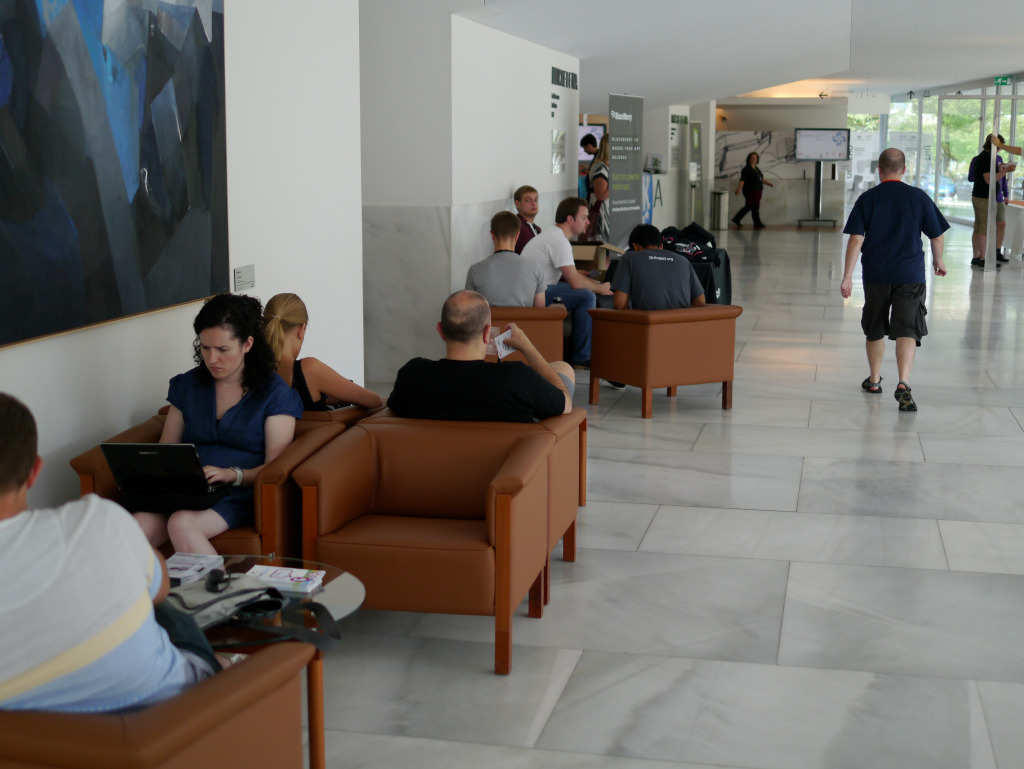
The hallway during talks
By Knut YrvinFollowing the keynote, talks commenced.
Kevin Krammer spoke about declarative widgets as KDAB has developed them. He showed how QML with widgets can create impressive UIs in a small number of lines of clear and easy to understand code. In his first demo, Kevin did some live coding, drawing applause several times. He explained some of the goals and considerations behind these technologies. He then showed how a single application can have significantly different user interfaces: one for users, another for staff and administration, and a developer UI incorporating all the others, which can load each of them with ease. Kevin also spoke about how the benefits of various interfaces to the same application go beyond different devices and formfactors. In the Q&A that followed the presentation, there was a question about the relationship between declarative widgets and the new widgets in Qt 5.1. Kevin sees declarative widgets as a step in moving from a traditional widget-based application to the flexibility of QML.
Read More